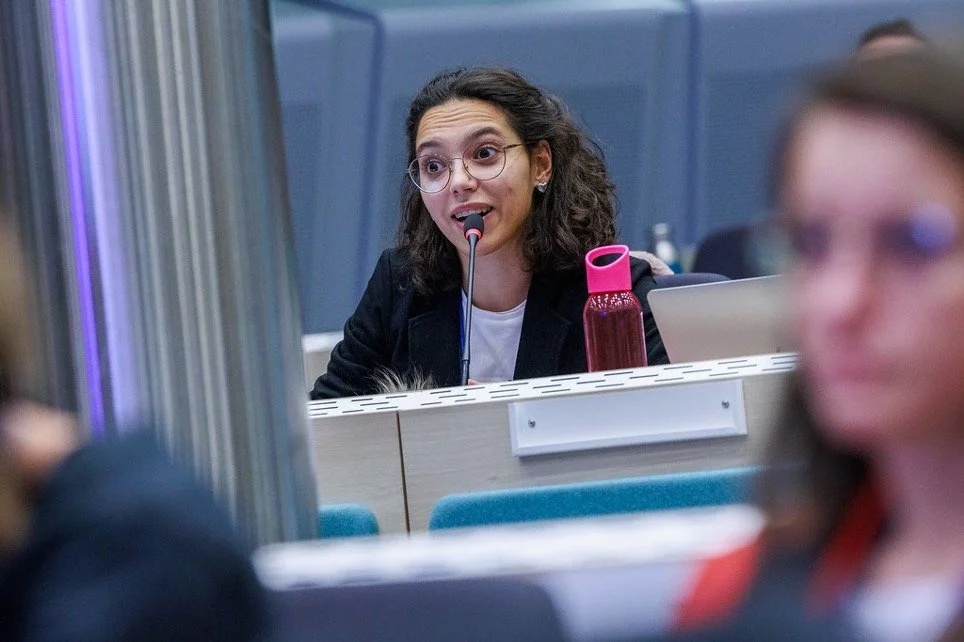
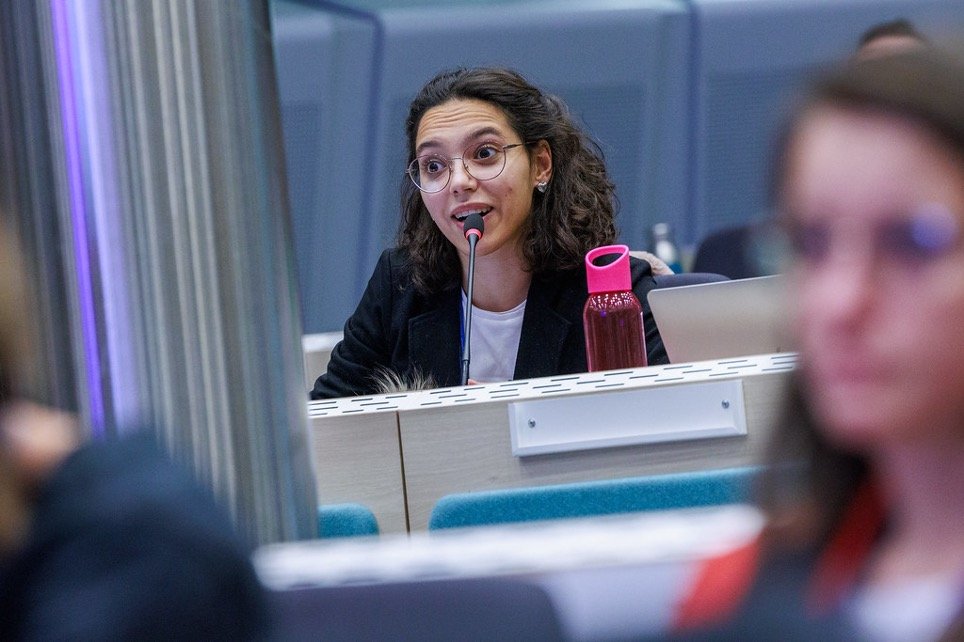
Ospitiamo qui la testimonianza di Fatiha Quaratino, invitata a partecipare il 4 e 5 Dicembre 2025 a Bruxelles, alla Giornata Europea delle Persone con Disabilità (EDPD2025), in rappresentanza del gruppo Giovani Adulti Fightthestroke e CP-ECA Youth Committee.
‘All’EDPD 2025 ho faticato a capire cosa raccontare di quei tre giorni e di quei tre panel. Si è parlato di tutto: disabilità, politiche europee, modifica dei trattati, risorse economiche, inclusione, autonomia, indipendenza, qualità della vita, istruzione, lavoro. Ho ascoltato discorsi intensi, tra cui quello straordinario di un veterano ucraino di 23 anni. Tutto importante. Tutto necessario.
Ma queste cose le troverete nei report europei che usciranno con l’anno nuovo. Quello che voglio raccontare è altro, perché il nodo vero non sta solo lì. Sta nel futuro.
In un’aula piena di teste bianche, chi fuori e chi dentro, anche la mia lingua, di solito senza freni, si è fermata. Ho parlato poco, ascoltato molto, osservato ancora di più. Ed è stato bellissimo. Ho capito che mi piace il parlare che si trasforma in fare, che il futuro vero è fatto di esperienze condivise e che non può restare prigioniero dei soliti paradigmi dei “poveri disabili senza risorse”. Le risorse, a volte, stanno nei posti più impensabili: in una piscina, su una pista di atletica, in un campo da calcio, al Fight Camp, nelle chiacchierate, in qualche pianto condiviso, nelle idee nuove, nella scienza, nei professionisti che fanno ricerca e quelli che si prendono cura di noi. L’importante, quindi, è allenare così bene il quotidiano ai nostri bisogni a tal punto da non doverli mai più raccontare una volta all’anno all’istituzione di turno, perché L’istituzione saremo diventati noi.
Una delle cose più belle è stata vedere come la disabilità viene vissuta in contesti sociali diversi. Stessi diritti rivendicati, bisogni simili, ma sguardi, linguaggi e pratiche profondamente differenti. Questo confronto continuo mi ha ricordato quanto sia miope pensare a soluzioni uniche per persone che uniche lo sono davvero.
La parte migliore, alla fine, sono state le relazioni umane. Le associazioni internazionali incontrate nei corridoi, le conversazioni nate senza bisogno di badge o presentazioni, il sentirsi parte di qualcosa di molto più grande. Anche il cibo, oggettivamente poco memorabile, mi ha fatto guadagnare il soprannome dell’“Italiana”. Ho anche finalmente capito perché mangiano così tanto a colazione: fa davvero freddo e, visto cosa mangiano, ti passa la fame per l’intera giornata.
È stato bellissimo condividere questa avventura con Laura e Agnes. Siamo molto diverse e proprio per questo, insieme, siamo riuscite a raccontare anche visivamente quanto la nostra patologia abbia bisogno di risorse differenti, perché le persone sono tutte diverse. Già questo, per me, è un messaggio politico fortissimo. Non teorico, ma pratico. Non dichiarato, ma incarnato.
Sono partita con una valigia che si è rotta la mattina stessa della partenza. Un ottimo inizio. L’ho sostituita più tardi con una nuova, poco sobria, rosa. Anche questo, col senno di poi, mi sembra coerente.
Ho preso due aerei e due taxi da sola. Con mia mamma in ansia costante, naturalmente. A un certo punto mi è sembrato giusto spingermi anche nel centro di Bruxelles e provare la metro e a comprarle una calamita che ama tanto nonostante il suo implorarmi di rimanere “al sicuro”. L’ho fatto. E l’ho omesso fino al ritorno. Non per mancanza di affetto, ma perché preferirei restare l’unica in famiglia ad aver deciso di “provare” il brivido di un ictus.
Tra i paradossi di questa esperienza ce ne sono stati molti. Bruxelles, cuore delle politiche europee, non è poi così accessibile. In albergo la doccia era dentro la vasca: una perfetta metafora della vita quotidiana di tante persone con disabilità, fatta di soluzioni parziali e adattamenti continui. Eppure, anche questo mi ha confermato di essere nel posto giusto, scoprendomi per l’ennesima volta capace.
Da una parte è stato bello sentirsi “diverse” e a tratti poco orientate in certi discorsi e in certi contesti. Col senno di poi l’ho interpretato come un segno della nostra forza: come associazione sappiamo restare concentrate sui problemi, ma scegliamo di risolverli non chiudendoci tra di noi, bensì spingendoci nel mondo.
Ogni panel era tradotto in lingua dei segni e, alla fine, un’artista sintetizzava tutto disegnando. Non parole, ma immagini che sono molto felice di condividere con voi e che vi daranno un’idea di quello che troveremo nel report. Un promemoria potente: non tutto passa dalla voce, e non tutto si capisce parlando.
C’è stata anche una cena con il karaoke. I canti li abbiamo aperti noi italiani, i racconti si sprecano. Lingue diverse, accenti diversi, risate che non avevano bisogno di traduzione. Europa, anche questa.
Ho trovato il coraggio di alzare la mano e fare una domanda senza la certezza di una risposta: quali politiche intendono pensare e attuare a favore dei caregivers informali? L’ho fatto pensando ai genitori incontrati in questi anni: fieri, determinati, ma stanchi. Perché la disabilità non riguarda mai la sola persona con disabilità, ma tutto il suo tessuto sociale. Più forti insieme, più futuro per tutti.
Forse il mio faticare con la lingua è stato il segnale più onesto: prima di agire, bisogna imparare. Perché quello che facciamo in FightTheStroke merita un agire buono, capace di portare, un passo alla volta, la rivoluzione di paradigma che viviamo ogni giorno anche nei codici e nei trattati.
È stato profondamente emozionante parlare a nome di FightTheStroke. Vedere il suo nome sul pass della Commissione europea, sentire il peso e insieme la forza di rappresentare migliaia di persone, mi ha dato una carica enorme. Il fatto che Francesca abbia scelto di mandare me, che per anni mi sono incastrata nelle paure e nei limiti che la diagnosi mi poneva, lasciando che mi congelassero. L’ho sentito come un gesto potentissimo. Un atto di fiducia che mi ha attraversata tutta.
La calamita è piaciuta alla mamma, la valigia pure, ma credo che i racconti di più. Credo che tutta questa esperienza abbia reso orgogliosi i miei genitori e le persone che mi vogliono bene, ma la forza e la fiducia in me stessa che mi ha donato, sono state una molla potentissima verso il futuro che sogno.
Se mi sarà data la possibilità, non vedo l’ora del prossimo EDPD. Per ascoltare meglio, agire di più e fare ancora meglio la mia parte, in rappresentanza degli ideali che muovono il luogo sicuro quale è FightTheStroke per molti di noi.
Eravamo in un’aula intitolata ad Alcide De Gasperi.
E lì ho capito che l’Europa non è un luogo né un documento, ma una scelta quotidiana: decidere se il futuro sarà scritto per pochi o costruito con tutti.
Fightthestroke ha già scelto da che parte stare. E io con lei.’
Qui un approfondimento dei temi trattati, accessibili anche con le immagini:
Panel 2 - Funding the Union of Equality: towards a Disability-Inclusive EU budget
Panel 3 - Preparedness and crisis management inclusive of persons with disabilities
Da Bruxelles, pubblicato il 18 Dicembre 2025
ENGLISH TRANSLATION
“I went to the heart of Europe to dream of a better Europe—and I discovered that it already exists. It is FightTheStroke. It is us.”
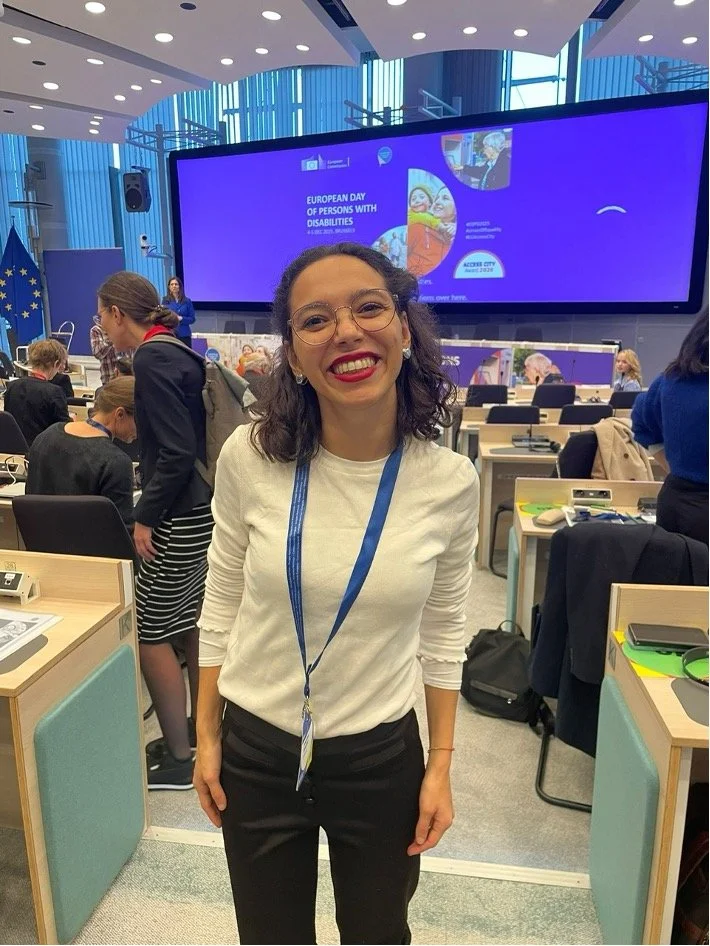
Here we share the testimony of Fatiha Quaratino, invited to take part on 4–5 December 2025 in Brussels in the European Day of Persons with Disabilities (EDPD 2025), representing the FightTheStroke Young Adults group and the CP-ECA Youth Committee.
“At EDPD 2025 I struggled to understand what to tell about those three days and those three panels. Everything was discussed: disability, European policies, treaty reform, economic resources, inclusion, autonomy, independence, quality of life, education, employment. I listened to intense speeches, including the extraordinary one by a 23-year-old Ukrainian veteran. All important. All necessary.
But you will find these topics in the European reports that will be published in the new year. What I want to talk about is something else, because the real core issue is not only there. It lies in the future.
In a room full of white heads—both figuratively and literally—even my tongue, usually unrestrained, came to a halt. I spoke little, listened a lot, and observed even more. And it was beautiful. I realized that I like words that turn into action, that the real future is made of shared experiences, and that it cannot remain trapped in the usual paradigms of “poor disabled people without resources.” Resources are sometimes found in the most unexpected places: in a swimming pool, on an athletics track, on a football field, at Fight Camp, in conversations, in shared tears, in new ideas, in science, in professionals who do research and in those who take care of us. What truly matters, then, is training everyday life so well around our needs that we no longer have to recount them once a year to whichever institution happens to be in charge—because we will have become the institution ourselves.
One of the most beautiful things was seeing how disability is experienced in different social contexts. The same rights being claimed, similar needs, but profoundly different perspectives, languages, and practices. This ongoing comparison reminded me how short-sighted it is to think of one-size-fits-all solutions for people who are genuinely unique.
In the end, the best part was the human relationships. The international organizations met in the corridors, conversations born without the need for badges or introductions, the feeling of being part of something much bigger. Even the food—objectively not very memorable—earned me the nickname “the Italian.” I also finally understood why they eat so much for breakfast: it’s really cold, and given what they eat, you won’t feel hungry for the rest of the day.
It was wonderful to share this adventure with Laura and Agnes. We are very different, and precisely because of that, together we managed to show—also visually—how our condition requires different resources, because people are all different. This alone, for me, is a very powerful political message. Not theoretical, but practical. Not proclaimed, but embodied.
I left with a suitcase that broke on the very morning of departure. A great start. I later replaced it with a new one, not very sober, pink. In hindsight, this too seems consistent.
I took two planes and two taxis on my own. With my mum in constant anxiety, of course. At a certain point, it felt right to push myself further into the center of Brussels, try the metro, and buy her a souvenir magnet that she loves so much—despite her pleading with me to stay “safe.” I did it. And I kept it to myself until I got back. Not out of lack of affection, but because I’d prefer to remain the only one in the family who decided to “try out” the thrill of a stroke.
There were many paradoxes in this experience. Brussels, the heart of European policymaking, is not that accessible after all. In the hotel, the shower was inside the bathtub: a perfect metaphor for the daily life of many people with disabilities, made up of partial solutions and constant adaptations. And yet, even this confirmed that I was in the right place, discovering once again that I am capable.
On the one hand, it was nice to feel “different” and at times slightly disoriented in certain discussions and contexts. In hindsight, I interpreted this as a sign of our strength: as an association, we know how to stay focused on problems, but we choose to solve them not by closing in on ourselves, but by pushing out into the world.
Every panel was translated into sign language and, at the end, an artist synthesized everything through drawings. Not words, but images, which I am very happy to share with you and which will give you an idea of what we will find in the report. A powerful reminder: not everything goes through voice, and not everything is understood by speaking.
There was also a dinner with karaoke. We Italians kicked off the singing—there are countless stories to tell. Different languages, different accents, laughter that needed no translation. Europe, this too.
I found the courage to raise my hand and ask a question without being certain of an answer: what policies do you intend to design and implement in support of informal caregivers? I asked it thinking of the parents I have met over the years—proud, determined, but tired. Because disability never concerns only the person with a disability, but their entire social fabric. Stronger together, more future for everyone.
Perhaps my struggle with language was the most honest sign of all: before acting, one must learn. Because what we do at FightTheStroke deserves good action—capable of bringing, step by step, the paradigm shift we live every day also into codes and treaties.
It was deeply moving to speak on behalf of FightTheStroke. Seeing its name on the European Commission pass, feeling the weight and at the same time the strength of representing thousands of people, gave me enormous energy. The fact that Francesca chose to send me—me, who for years had been stuck in the fears and limits imposed by my diagnosis, letting them freeze me—felt like an incredibly powerful gesture. An act of trust that went straight through me.
My mum liked the magnet, the suitcase too, but I think she liked the stories even more. I believe this whole experience made my parents and the people who care about me proud, but the strength and confidence in myself that it gave me have been a powerful springboard toward the future I dream of.
If I’m given the chance, I can’t wait for the next EDPD. To listen better, act more, and play my part even better, representing the ideals that drive FightTheStroke as the safe place it is for many of us.
We were in a room named after Alcide De Gasperi.
And there I understood that Europe is not a place nor a document, but a daily choice: deciding whether the future will be written for a few or built with everyone.
FightTheStroke has already chosen which side to stand on. And I stand with it.”**
Further information on the topics discussed, also accessible through images:
Panel 2 - Funding the Union of Equality: towards a Disability-Inclusive EU budget
Panel 3 - Preparedness and crisis management inclusive of persons with disabilities
From Brussels, published here on the 18th of December 2025